To choose the right dog coat size, measure three things while your dog stands: back length, chest girth and neck. Then compare them with the size chart of the specific coat, not with a weight band. Weight is a poor guide on its own, and it is worst for long-backed breeds like the Dachshund. If your dog is a Dachshund, our Dachshund Sizing & Gear Finder takes those measurements and turns them into coat, fleece and harness sizes across brands, so you are not decoding a different chart for every shop.
This guide covers the measuring routine, how to read a size chart, how a coat should fit, and what changes for puppies and for dogs with back concerns.
TL;DR
- Measure back length (collar base to tail base), chest girth (widest part of the rib cage, behind the front legs) and neck, with a soft tape and your dog standing.
- Back length is the measurement that matters most for a coat, because straps can adjust girth but cannot lengthen a coat.
- Use the two-finger rule: you should be able to slide two fingers under the tape and under every strap or opening. If your dog falls between sizes, size up.
- Never choose by weight alone. Two dogs of the same weight can have very different measurements.
- Dachshunds and growing puppies need extra care: a long back and short legs break most standard charts, and a puppy's measurements keep changing.
Table of Contents
- Why weight alone gives the wrong coat
- What you need before you measure
- How to measure your dog for a coat, step by step
- Reading a dog coat size chart
- Chart quick reference
- How a coat should fit
- Dachshunds: why the standard chart fails
- Puppies: choosing a coat for a growing dog
- What size for a 15-pound dog, or a Chihuahua?
- Picking the right type of coat
- Keeping your measurements and fit notes together
- Get a coat size across brands without redoing the maths
- Mistakes that cause most coat returns
- FAQ
- Sources
Why weight alone gives the wrong coat
A "15 lb dog" could be a Chihuahua, a Miniature Dachshund, a small terrier or a leggy crossbreed. Each has a different body length, chest depth and neck. The American Kennel Club makes the point plainly: a 30-pound French Bulldog and a 30-pound Basset Hound can have very different measurements, which is why it advises measuring neck, chest, stomach and back length rather than relying on a weight label.
Weight bands on a chart are a rough shortcut for the shop, not a fitting method. Use them only to decide which column of the chart to look at first, then confirm with the tape.
This matters most for Dachshunds. A dog with a long back, a deep chest and short legs will often fit a coat in chest girth but find it ends halfway down the spine, or fit the length but find it billows around the body. Coats cut for a "typical" dog silhouette are the usual culprit.
What you need before you measure
- A soft tape measure, the sort used for sewing. A rigid builder's tape will not follow the body.
- Your dog standing square on all four paws, head up and relaxed. Measuring a sitting or curled-up dog adds or removes centimetres.
- A treat or a helper if your dog fidgets.
- A pen and paper, or your phone, to write each number down straight away.
Work in either centimetres or inches, but match the unit of the chart you are reading. Many UK coats list both, and plenty list inches only, so check before you compare.
How to measure your dog for a coat, step by step
1. Back length
This is the number that decides most coat purchases. Veterinarian Jennifer Freeman, DVM, quoted by DailyPaws, recommends measuring body length from the base of the collar to the base of the tail and treats it as the most important of the three, because a coat's length cannot be altered with straps.
Find the base of the neck, where a collar naturally sits, and run the tape along the spine to where the tail starts. Keep the tape flat on the back, not pulled over a curve of fur.
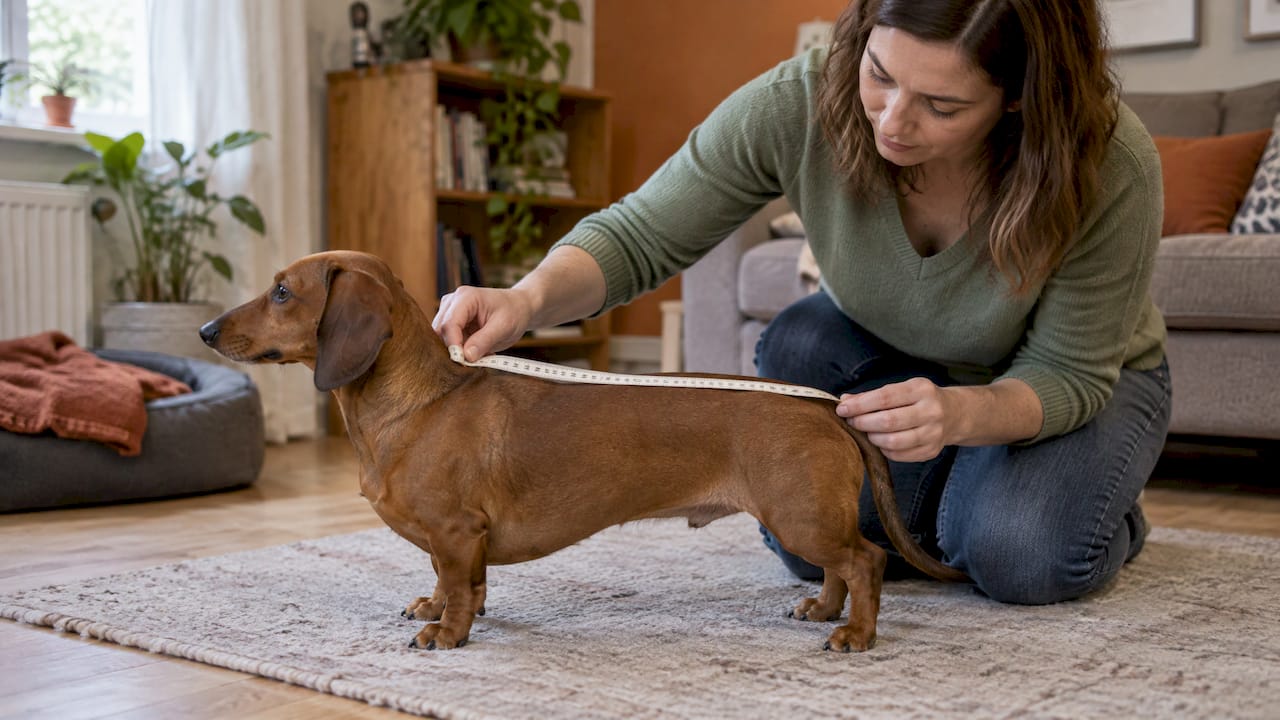
Where it goes wrong: starting from the top of the head or the shoulder blade instead of the collar line, or finishing at the tail tip. Either gives a number several centimetres out, and for a short-legged breed a small error means a coat that stops short of the loin or drags over the tail.
For a Dachshund this is also the measurement most charts handle worst, since the length-to-girth ratio is unusual. Our Dachshund Sizing & Gear Finder is built around that ratio, and it takes your dog's own dimensions and returns coat, fleece and harness sizes across brands.
2. Chest girth
The AKC's measuring guide says to wrap a soft tape around the largest part of the rib cage, usually just behind the front legs, with your dog standing. Keep it snug but not tight, and check you can slip two fingers between the tape and your dog. Then write the number down and compare it with the coat's own chart.
Where it goes wrong: measuring too far forward over the shoulders, letting the tape slope so it is lower on one side, or pulling it tight into a thick coat of fur. For a fluffy or wire-haired dog, press the fur flat gently as you measure so you are measuring the body and not the fluff.
3. Neck
Measure around the neck where a collar normally sits. PetMD, in an article reviewed by a veterinarian, gives the same instruction for the neck, and advises leaving a finger or two of room.
Neck matters for coats with a high collar or a fastening at the throat. A neck that is too snug is uncomfortable and can rub on a short-coated dog. A neck opening that is too wide lets rain and wind straight down the back.
4. Optional: girth behind the ribs and underbelly coverage
The AKC also lists stomach measurements. If you are buying a waterproof coat or a full-body fleece, measure the girth just in front of the back legs, and note how far you want the coat to cover underneath. Male dogs usually need the belly flap to stop short of the groin, and the chart may not say how far it goes. If it does not, this is one more reason to rely on the back length and be generous with the girth.
Reading a dog coat size chart
Every brand uses its own labels. One brand's medium is another's small, and "XS" may mean a toy dog in one chart and a small terrier in another. So do not carry a size from one brand to another. Instead:
- Take your three measurements.
- Find the column for back length first. Pick the size whose back length is equal to or slightly longer than your dog's.
- Check the chest girth for that size. It should be at least your measurement plus 1 to 2 inches (about 2.5 to 5 cm) of ease. PetMD suggests adding 1 to 2 inches for a snug but unrestricting fit.
- Check the neck.
- If your dog falls between two sizes, go up. PetMD gives the same advice, and the AKC says a slightly looser fit is preferable to one that constricts the pet.
If the chart only lists weight, or only lists a single length, treat it as incomplete for a long-backed dog and look at the product page for a full measurement table before ordering.
A worked example
Imagine an adult Dachshund with a back length of 38 cm, chest girth of 40 cm and neck of 28 cm. A coat listed as medium might offer a back length of 35 cm and a chest range of 38 to 46 cm. The chest looks fine, but the back is 3 cm too short, so it would leave the lower back bare. The next size up might have a 40 cm back and a chest of 42 to 50 cm. The chest is looser, but you can pull the straps in and the length is right. The larger size is the better buy. That is exactly the trade-off the standard advice describes: length first, girth adjusted afterwards.
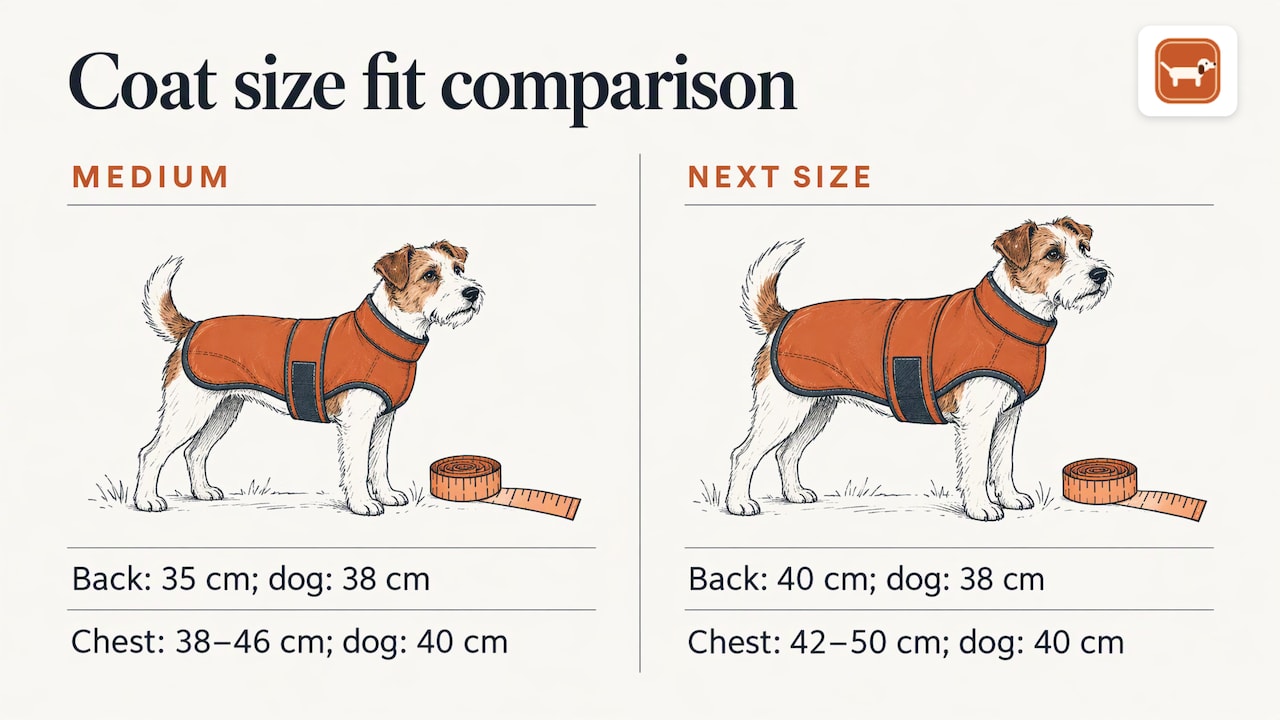
Chart quick reference
Use this table as a way to organise your numbers, not as a replacement for the chart of the coat you are buying.
| Measurement | Where to measure | What to compare it with | Ease to allow |
|---|---|---|---|
| Back length | Base of collar to base of tail, dog standing | Coat length on the chart | Equal or slightly longer |
| Chest girth | Widest part of the rib cage, behind front legs | Chest range on the chart | Two fingers, about 1 to 2 inches |
| Neck | Where a collar sits | Neck range on the chart | One to two fingers |
| Belly girth (optional) | Just in front of the back legs | Belly coverage or girth range | Comfortable, no pull |
How a coat should fit
A coat that fits on the tape can still fit badly on the dog. Check these once it is on:
- The flat-hand test. DailyPaws' fit advice is that you should be able to run a flat hand under the openings at the neck and straps. If you cannot, size up.
- Movement. The AKC says a coat should not restrict movement and should not be so loose that rain seeps in. Watch your dog walk, trot and sit. A coat that rides up, twists or makes the legs swing oddly is wrong.
- No rubbing. Look at the armpits and the neck after a walk. Flattened or reddened fur is a sign that something is chafing.
- Coverage. The coat should reach the base of the tail without covering it, and the chest panel should sit between the front legs without pulling them inwards.
- Fastenings. Straps and Velcro should sit on the side or belly, not on the spine, and should lie flat.
Do this indoors first, then on a short walk, before removing any tags.
Dachshunds: why the standard chart fails
The Dachshund's proportions are the whole difficulty. The body is long, the chest is deep and the legs are very short. A standard chart assumes length and girth grow together. On a Dachshund, length runs ahead.
Three practical rules follow:
- Let back length choose the size, then check that the chest has enough room. If the chest is too tight in the size that fits the length, look for adjustable straps or another cut rather than squeezing the dog into a smaller coat.
- Watch the front legs. Short legs mean coats with deep front panels or leg openings can rub at the elbow. Check that your dog can take a full stride.
- Avoid anything heavy or stiff along the spine. Choose a coat whose weight sits evenly and that lies flat.
If your Dachshund has been diagnosed with IVDD (intervertebral disc disease, a condition where the discs between the spine's bones can bulge or rupture), or you have noticed signs of back pain, talk to your vet before choosing or changing gear. Your vet can tell you how much support and how much freedom of movement your dog needs, and can advise on keeping weight in a healthy range. Apart from that, the fitting rules above apply: a coat that is too tight at the chest or neck is more than an annoyance, and you should never force a dog into a garment that restricts its stride.
Puppies: choosing a coat for a growing dog
A puppy's measurements change quickly, and not all at once. PetMD says that if a dog is not fully grown, you might consider an adjustable item rather than a fixed-size one.
A sensible routine for a puppy:
- Re-measure before every purchase, even if you measured a few weeks ago.
- Run the two-finger check each time you put a coat on, since a coat that fitted last month may now pinch at the neck or ride short on the back.
- Expect length to change differently from girth. A puppy can get longer without getting much wider, so the coat can become too short while the chest still feels fine.
- Buy for the current season, not for the adult dog. A coat bought to be "grown into" will hang off the puppy and let the rain in.
If you want to plan ahead, the puppy adult-size estimate in our Dachshund Sizing & Gear Finder uses your puppy's measurements to estimate adult sizes, so you can see how far your puppy still has to grow before choosing a long-term wardrobe.
What size for a 15-pound dog, or a Chihuahua?
There is no single answer, and this is why weight-based charts disappoint. A 15 lb dog could be a long Dachshund, a compact Chihuahua or a deep-chested terrier. Measure first, then look at the back length column.
For a Chihuahua, the same three measurements apply. Small breeds often have a proportionally larger neck and a shallow chest, so check the neck opening and the chest range together, and size up if the dog sits between two. Dachshunds and Chihuahuas can weigh the same but need very different coat lengths, so avoid a coat sold as "fits small dogs" and read its measurements.
Picking the right type of coat
Once you have the size, match the coat to the job:
- Waterproof coats and rainwear for wet walks. Make sure the length reaches the tail base, since rain gets in at the gaps.
- Fleeces and jumpers for dry cold or for indoor warmth. Because they stretch, check they do not pull on the chest when your dog stretches.
- Insulated winter coats for short-coated or older dogs on cold days. These have more bulk, so check the leg openings and straps.
The Dachshund Sizing & Gear Finder covers harnesses, coats and rainwear, and fleeces and jumpers, so one set of measurements can serve every item.
Keeping your measurements and fit notes together
Most owners measure once, forget the numbers and measure again for the next purchase. A better habit is to write down the date, the three measurements, your dog's weight and which coat size you bought and how it fitted. Over a year, that tells you how your dog has changed and which cuts suit him.
Sausage Fit lets you save your dog's measurements, log weight and health metrics, and keep a saved gear wardrobe with fit notes in one place.
Get a coat size across brands without redoing the maths
The awkward part of buying a coat is that every brand names sizes differently. Our Dachshund Sizing & Gear Finder lets you enter your dog's dimensions and returns cross-brand size recommendations for harnesses, coats, fleeces and recovery suits. It also includes puppy adult-size estimates, weight and health-metric tracking, and a saved gear wardrobe with fit notes.
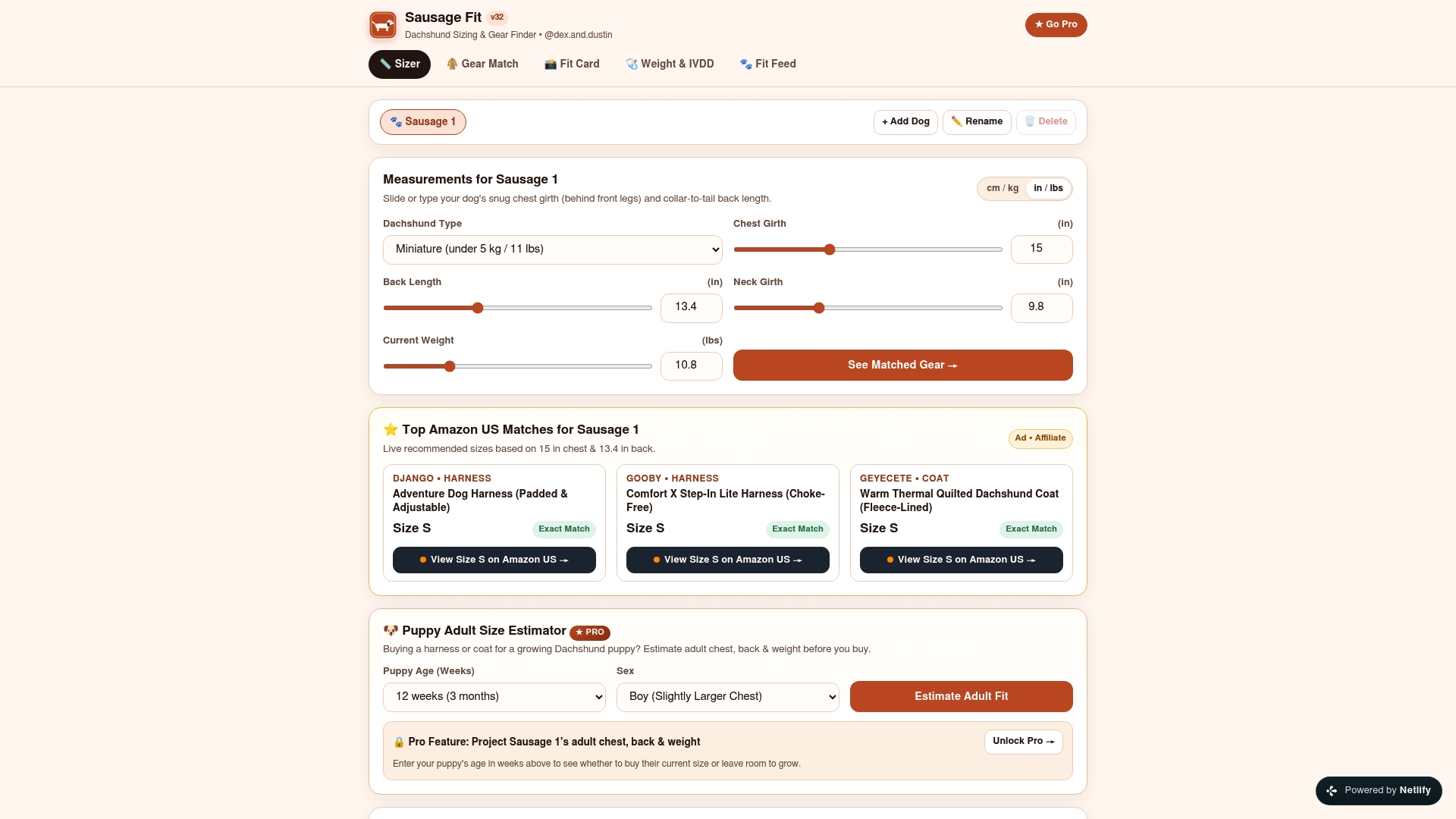
Sausage Fit Pro costs £2.99 per month or £14.99 as a one-off payment. You can start from the Sausage Fit sizing tool.
Mistakes that cause most coat returns
- Choosing by weight or breed label. Use the tape.
- Measuring a dog that is not standing. Sitting compresses the chest and shortens the back.
- Starting the back length in the wrong place. Use the collar base, not the head.
- Ignoring the length when the girth fits. Girth can be adjusted, length cannot.
- Buying snug. A snug coat on the tape is a tight coat on the dog.
- Skipping the fit check. Do the flat-hand test at the neck and every strap.
- Never re-measuring. Dogs change, especially puppies and dogs whose weight shifts with the seasons.
FAQ
How do I measure my dog's chest for a coat?
With your dog standing, wrap a soft tape around the widest part of the rib cage, just behind the front legs. Keep it snug but loose enough to slide two fingers beneath it, as the AKC advises. Write the number down and compare it with the coat's own chart.
What size coat does a 15-pound dog need?
Weight alone cannot tell you. Dogs of the same weight can have very different lengths and chests, so measure back length, chest and neck, and pick the size from the chart of the coat you are buying.
What if my dog is between two sizes?
Size up. Both the AKC and PetMD recommend the larger size, since a slightly loose coat is better than one that constricts. Then adjust the straps and run the flat-hand test at the neck and chest.
How often should I re-measure a puppy?
Measure before each purchase and check the fit every time the coat goes on, because a puppy can lengthen faster than it widens. A coat that fitted last month can quickly become too short on the back.